

Published on
Cooling Flow Quick Reference: Size Your Bore in 30 Seconds
On most shop floors, bore size is chosen by feel: bigger mold, bigger fitting.But one size down can cut flow by thirty percent — and once velocity drops, heat transfer drops with it. Warped parts, sink marks, and you'll never find the cause on the process sheet. One size up, and every hose, fitting and manifold has to grow with it. Cost and mold space, wasted for nothing.Bore size doesn't need guessing. It can be calculated.
The Four-Step Chain
Step 1 — Heat to remove. Part weight × effective specific heat × temperature drop (melt minus demold). For ABS cooling from 220°C to 80°C, use about 2 kJ/(kg·K). A 0.5 kg part carries roughly 140 kJ.Step 2 — Heat flux. Divide by cooling time. Our 0.5 kg part, 25 seconds: about 5.6 kW. Note that wall thickness affects cooling time quadratically — double the wall, and cooling time roughly quadruples.Step 3 — Flow rate. Divide by (water specific heat × ΔT). Design the water temperature rise at 3–5°C; at 4°C: 5.6 kW ÷ (4.2 × 4) ≈ 0.33 L/s — about 20 L/min.Step 4 — Bore. At 1.5 m/s, the practical floor for turbulent flow, 20 L/min needs about 222 mm² of cross-section — an inner diameter near 17 mm. Choose DN20, or split into two DN13 circuits. Big parts don't always need big bores. Sometimes they need more circuits.
The Quick Reference Table
(Assumes 4°C water rise, 1.5 m/s, per circuit)
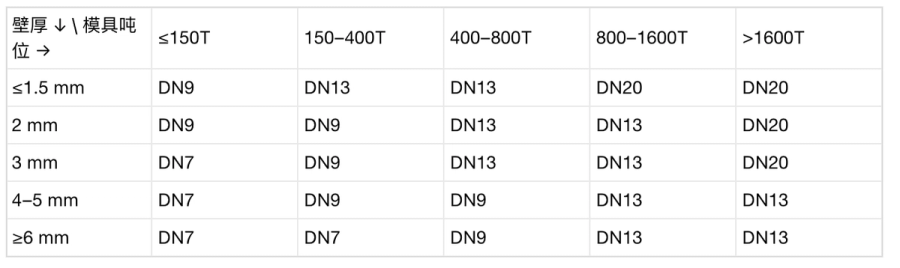
Understanding the logic matters more than memorizing numbers: tonnage stands for total heat, wall thickness for cycle time. Thin-wall, large-mold is the most flow-hungry combination — big heat, short cycle. Thick parts carry plenty of heat too, but their longer cycles relax the per-circuit demand.
Two Corrections
Multi-cavity molds: add circuits, not bore. Twice the cavities, twice the heat — split it across more circuits rather than doubling one bore. Each circuit still gets checked against 1.5 m/s.Uneven walls: time from the thickest section, heat from the total weight. Don't mix the two up.
When the Table Doesn't Apply
Hot molds (>120°C): check pressure and temperature ratings first, then flow.
TCU circuits: high loop resistance; 1.5 m/s may be hard to reach — verify against the pump curve.
Long runs: every 90° elbow adds resistance equal to 30–40 pipe diameters of straight run. Confirm end-of-line flow with a meter.
Three Common Misuses
Reading tonnage only — the same 500T machine wants different bores for thin and thick walls.
Treating total flow as per-circuit flow — a 200 L/min supply says nothing about any single branch. Measure each one.
Ignoring elbows and reducers — their resistance can exceed the main line's.
The Bottom Line
Bore size is calculable. Calculate first, choose the brand second — in reverse order, no brand can save the flow budget.