

Veröffentlicht am
How Fast Does a Cooling Upgrade Pay Back? A Model You Can Copy
Pitch a cooling upgrade and you'll hear the same objection: "It still works fine."
You can't win that argument with technical detail. You win it with payback. The question was never "should we spend?" — it's "how many months until this pays for itself?" Once the math is on the table, the debate is over.
Three Revenue Items
1. Shorter cycle time. Cooling takes up 60% of the molding cycle — the only big block you can compress. Revenue = monthly shots × reduction % × margin per shot. On a 45-second cycle, every second shaved adds roughly 1,000 shots per machine per month.
2. Lower scrap rate. More uniform mold temperature means less warpage and fewer dimensional rejects. Monthly output value × scrap-rate reduction.
3. Electricity. Shorter cooling plus variable-speed pumping: running power × hours. The smallest item, but it recurs every month.
Three Cost Items
Parts and installation. Fittings, manifolds, piping. Downtime. Schedule it in the slow season: shutdown days × daily profit. Often bigger than the parts bill. Ongoing maintenance. Cleaning and seal replacement, amortized annually.
A Worked Example
Mid-size shop, 8 machines, 45-second average cycle, ~¥2M monthly output value:
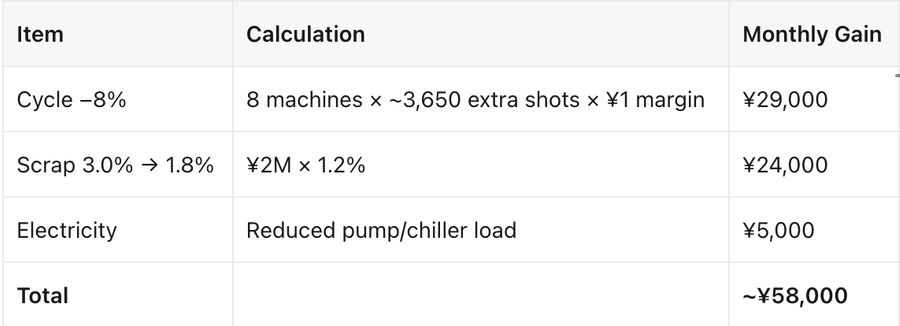
Investment: parts & installation ¥580K + 3 days downtime ¥150K + first-year maintenance ¥70K = ¥800K.
Payback = 800 ÷ 58 ≈ 14 months. After that, it's ¥58K a month of net gain.
What Moves the Number Most
Two variables dominate:
Utilization. Gains scale with actual running hours. Utilization dropping from 90% to 60% cuts revenue by a third — payback stretches past two years. If orders are thin, upgrade later.
Margin per shot. The same upgrade can yield very different paybacks in automotive versus commodity molding. In low-margin work, shift the focus from cycle time to scrap rate.
When Not to Upgrade
Utilization below 60% — the gains have nowhere to land.
Molds retiring within two years — the payback window outlives the assets.
End-of-line pressure drop is the real bottleneck — fix the circuit layout and bore sizes first; bigger pumps and fittings won't help. That's a different calculation, for another post.
The Bottom Line
A cooling upgrade isn't a matter of belief. It's a division problem.
Calculate first, upgrade second. An upgrade that can't pay back isn't investment — it's waste with good intentions.